Finding respite in community
How can I write an AusPATH conference report and travel diary without talking about everything happening at home?

I didn't think I'd be writing a post-AusPATH post like I have in previous years. There's so much to say this time. Travelling to be with my peers in trans health just days after the government announced a ban on reversible pubertal suppression for trans kids was a weird feeling of whakamā. Instead, on the plane home, I wrote about the ways I was taken care of by trans people in the days following the conference.
But this morning I read my previous conference diaries, after WPATH in 2024 and after AusPATH in 2023 - I love them as a record of my travels, my experiences, how I felt in the aftermath, and felt like I'd miss not having one for AusPATH 2025.
I can't talk about anything without talking about what's happened here in Aotearoa. Late on Wednesday 19th Nov, the day before Trans Day of Remembrance, the Minister of Health announced new incoming regulations that ban access to reversible pubertal suppression (puberty blockers) for trans kids specifically. On Thursday the community in Ōtautahi pulled together a vigil for Trans Day of Remembrance and a protest, a space to gather, to co-process what had happened.
We had 50 or so community members turn up - trans people, parents, whānau, allies. We held an open mic so people could share their whakaaro. People spoke with grief, fury, rage, hope. I'm grateful to the folks who pulled it together, everyone who spoke, everyone who came.
And of course, everything kicked into high gear right away. And there will be so much more to say when PATHA isn't engaged in this court process - it's feeling challenging, not being able to share everything fully, but it's really important that we preserve the integrity of that process.
Mate, where do I start. On Wednesday last week the govt banned blockers. It's been all go since then. It's horrible, but at the same time incredible to see the huge outpouring of support. So many major medical bodies have come out opposing the ban already, unprompted by us. I think we've got a strong case for judicial review. And in all this, I fly to Hobart at 4:45am tomorrow. I was so looking forward to it but now I'm feeling a bit daunted.
It's been exhausting. All I could do on Wednesday was cry, but we had to meet to write our statement. The next morning I asked the community if anyone could organise a vigil and everyone stepped up. It was beautiful - tender and angry and sad and hopeful. It's kind of been non-stop ever since.
On Tuesday, I flew to nipaluna Hobart. I ran into colleagues at the gate lounge in Tāmaki. "I'm so glad to see you" were the only words exchanged as we hugged. How jagged the juxtaposition, to see old friends in person for the first time in a long time, and it be coloured with the shock and grief about what was happening.
There were six of us on that flight, a contingent, a bubble. I had a row to myself and just tried to sleep.
It was my first time visiting lutruwita and I didn't expect it to feel so much like home. From the plane, the landscape looked familiar - patchwork fields of green and brown, except hilly rather than flat plain, dotted with lakes instead of drawn with braided rivers. nipaluna itself was similarly familiar - I heard that the colonial city planner that laid out Ōtautahi also designed nipaluna. It felt like I'd turn a corner and be in a different Aotearoa town: some buildings reminded me of Oamaru, the harbour and hills felt like Pōneke, the central city grid and malls like Ōtautahi.
My friend Tommy lived in nipaluna for a while, and gave us the Tommy Tour. It's a city drenched in queer history, did you know that? He took us to the Salamanca markets, where activists were repeatedly arrested for having a stall and collecting signatures on a petition to decriminalise homosexuality. In the 90s, when activists took a case to the UN Human Rights Committee seeking a declaration that criminalising homosexuality contravened the International Covenant on Civil and Political Rights and won, the declaration was read at Salamanca. Equality Tasmania still have a stall at Salamanca to this day.
Those first couple of days in nipaluna were a strange combination of wanting to explore and see everything I could see but needing to find quiet places to sit down and work - we had affidavits to write, emails and documents to collate, a case to build. The rest of the PATHA team arrived over the next few days. We spend so much time together on zoom that it's a surreal joy to see each other kanohi ki te kanohi at the best of times, but the mix of relief and grief to see each other in nipaluna, to hug, to huddle around a table in the hotel bar and work - it was like nothing else. I think we've probably all seen each other cry at this point.
I'm in Hobart, have been since Tuesday. It's been so good to see everyone in person. Our bnb is cute - up on a hill, 20 min walk from town, with a cute garden and great view. Tommy and Jack were having a chinwag when I got home last night - it was nice to see them as old friends. I'm feeling okay. Definitely tired, but manageable. Taking action feels good.
The conference itself kicked off on Thursday with a workshop on reversible pubertal suppression. I'm still reeling at the serendipitous timing - how quickly I went from those feelings of whakamā to feeling grateful at being together and having the opportunity to talk with our colleagues from Australia, learn from how they'd navigated the Queensland ban, start to put a plan into place. The workshop focused hugely on the politicisation of this care, and how we can respond to the bad-faith attacks on it. "They're asking for unobtainable evidence" was the first note I took.
The opening plenary on Friday was from Cal Horton, an incredible researcher based in the UK, focusing on the experiences of trans young people and their families. They've published their presentation so you can have a read. It's heavy - we knew it would be heavy. I get snippets of what life on the ground in the UK is like for trans people every now and then, and those snippets are horrible enough - but hearing the full story from Cal was massive, especially when our government are pointing to the UK as the reason for Aotearoa's ban, and looking to the UK's clinical trials as the source of best evidence for young people here.
Cal spoke a lot about medical violence, cis-supremacy, and defensive practice: the ways we change our practice to feel better protected from bad-faith attacks. But those attacks will always find something to criticise, and often the defensive changes to our practice cause more harm for trans people. Cal put it really simply: you cannot fight an anti-trans movement by embracing its core messages, and care designed in response to transphobic pressure centres anti-trans activists, not trans people.
I'm incredibly grateful for Cal's opening plenary - not just for sharing critical information about what's actually happening in the UK, but because it set the tone for the rest of the conference. The amount of people - clinicians included - I heard talking about defensive practice and medical violence over the next few days was like nothing else.
Cal's also written some reflections about AusPATH as a whole, which you should read here.
I was part of the opening panel alongside Cal and Asa Radix, the current WPATH President, talking about what's happening in each of our countries, the ways we can work together, the ways we can learn from how things have played out overseas. Someone used the phrase "countries like the UK, the US, and New Zealand" and I swear it's a miracle I didn't black out on stage.
What a jarring week - going from being around friends and peers to writing affidavits to talking with AusPATH folks to trying to focus on conference presentations. The lawyers want to file an injunction on Monday.
It was hard to stay focused on the content of presentations, being pulled in 10 different directions at once. Looking back, those three days are such a blur - everything happened so fast. I'm grateful to have taken notes, and to have written updates for myself every few days - even if some of them abruptly end mid-sentence.
What I take away from trans health conferences usually always happens outside of the presentation rooms, but there were a few that really stuck out to me. My friend Yalei gave an excellent session on using EMDR to target and lessen the impacts of gender dysphoria, gender minority stress, systematic and structural transphobia in really novel ways. I heard about a queer bereavement and suicide postvention service in Naarm that shared some really great thinking about the different forms queer grief can take.
We heard about new data about the rates of trans Australians seeing anti-trans messaging in the news or online spaces (72.2% weekly or more often, with 69% also seeing, hearing, or thinking about anti-trans violence or legislation overseas weekly or more often) and the impact that has on us ("In the 6 or 7 years I've been doing this research, I've never seen so many statistically significant results" across a huge number of adverse mental health outcomes). And we heard about the impacts of misgendering and deadnaming on trans young people - 57.4% of trans young people were misgendered daily, and it has a tangible effect on their ability to participate in public life, with higher psychological distress, anxiety, suicidal ideation and attempts, homelessness, and truancy alongside lower happiness.
Researchers were challenged on collecting assigned sex at birth by default in their work, and were asked to critically consider what exactly they intended to measure, and whether ASAB was a proxy for that. It was interesting to see the amount of pushback that suggestion received. And we heard about an incredible new tool in development for Supported Decision Making for trans people with intellectual disabilities, challenging the infantilisation and 'constructed disability' that often goes with assumptions about the capacity people with intellectual disabilities have. It was so cool to hear about how Victoria's conversion practices ban recognises that identity suppression can be environmental or systemic, so organisations have a responsibility to ensure their service isn't creating these environments.
We had submitted an abstract to present about the process of updating Aotearoa's national gender affirming healthcare guidelines, and how the Minister of Health had directly intervened to prevent their publication. Earlier in the year, right after they weren't published, we submitted an OIA request to get a copy of them that way, knowing that if they were released in an OIA they'd be in the public domain and we could safely publish them ourselves. The request was denied, of course, and we took it straight to the Ombudsman.
I had to update my slides for the guideline presentation multiple times that week - and then, on the Friday, the day before our session, we got an update from Simeon Brown's office. The Ombudsman had made a decision. The reason to withhold the guidelines (a decision under active consideration) no longer held up. We got a copy. Immediately we were on the phone to the lawyers, making sure everything was above board - we got the go-ahead and jumped on it immediately.
It's not the way I had envisioned launching these guidelines. I didn't even expect to be the one to launch them - so many people put so much hard work into them - the chapter authors, the leads, the reviewers, the artists. I had pictured having a launch party, being able to give people their flowers, having physical copies people could look through - because they're gorgeous. But that decision was taken away from us - and maybe we'll have a proper launch on home whenua, but all of a sudden our conference presentation on how we hadn't been able to publish the guidelines became a launch.
It was surreal, and the most nervous I've ever been giving a presentation - not in my mind, but in my body. My hands wouldn't stop shaking. We had ten minutes as part of a politics and human rights panel, and a packed room. We had a QR code to PATHA's website on the last slide along with a photo of the front cover, and our website immediately crashed with the traffic. The kiwis in the audience stood and sung as I held back tears - tears of joy, relief, grief that not everyone who should have been there was in the room.
The guidelines are out in the wild now, free to use and to read. From my perspective, they're the authoritative clinical guidance for Aotearoa - it's the version approved by Te Whatu Ora's Clinical Governance Group and executive leadership team, before any political interference from the Minister. (AusPATH have also just published version 2 of their standards of care for informed consent gender affirming hormone therapy, which touches on some important things we don't, so are worth a read, too.)
You ever get rejection sensitive dysphoria from your whole country? When the plane lands the usual sense of relief to back on the whenua of Aotearoa isn't there in the same way, is poisoned by what the government has done, tainted my love for the land I'm privileged to call home. I know it is not the land's fault. I am heartbroken.
I stayed in nipaluna for a few days after the conference - when I booked the trip, I thought of those days as a holiday, a break in a new city, a chance to explore. I didn't expect them to turn out that way - too many urgent deadlines, too many things to get in place. But in the days following the conference, I landed in the care of trans people, who enabled that rest to happen. Huge dinners of cheap and cheerful food - dumplings, noodles, nasi goreng - with other trans people working in these weird and surreal spaces, in public facing positions or behind the scenes, but all of us singularly focused on trans people's right to self determination, bodily autonomy, existing in public - just getting to live flourishing, normal lives without the incessant attacks from those obsessed with us.
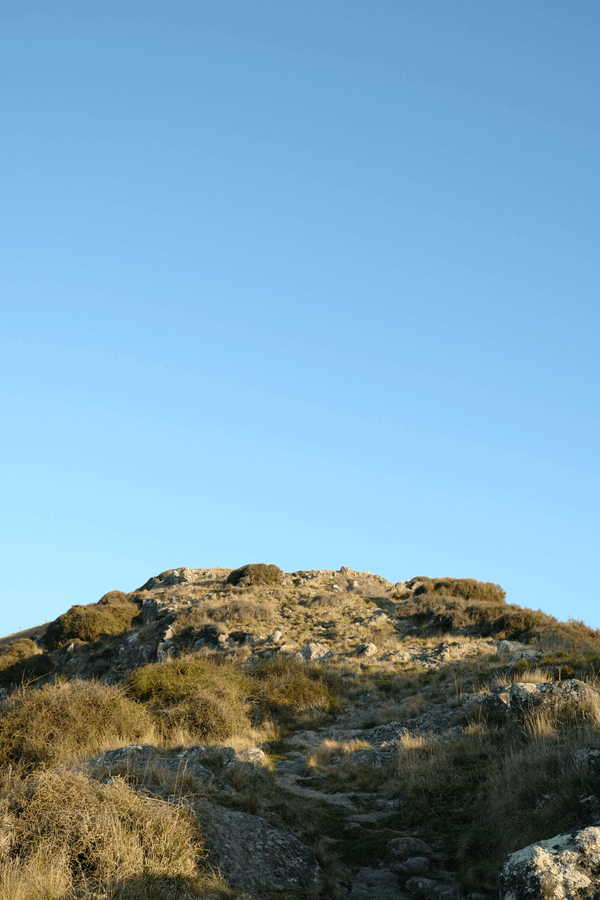
Yalei took me to stay a night at their whare out by the beach, a wee ways out of nipaluna, where we walked through country and up a maunga with a view out over their little town, and down to the beach. For the first time in over a week, I had stopped thinking about work. They made me dinner and we sat in front of the fireplace and yarned into the evening like we'd known each other forever.
When I’m feeling hurt and disconnected and place that onto the lands because of the actions of the government, it’s trans people that remind me the government is not the whenua. My friend in nipaluna, a twice-a-week cold water swimmer, sends me a photo of a book their friend sent to them. Circled on the page is the line “I do not have the words to describe the feeling of being in the ocean in a trans body other than to say is it right. Absolutely right.”
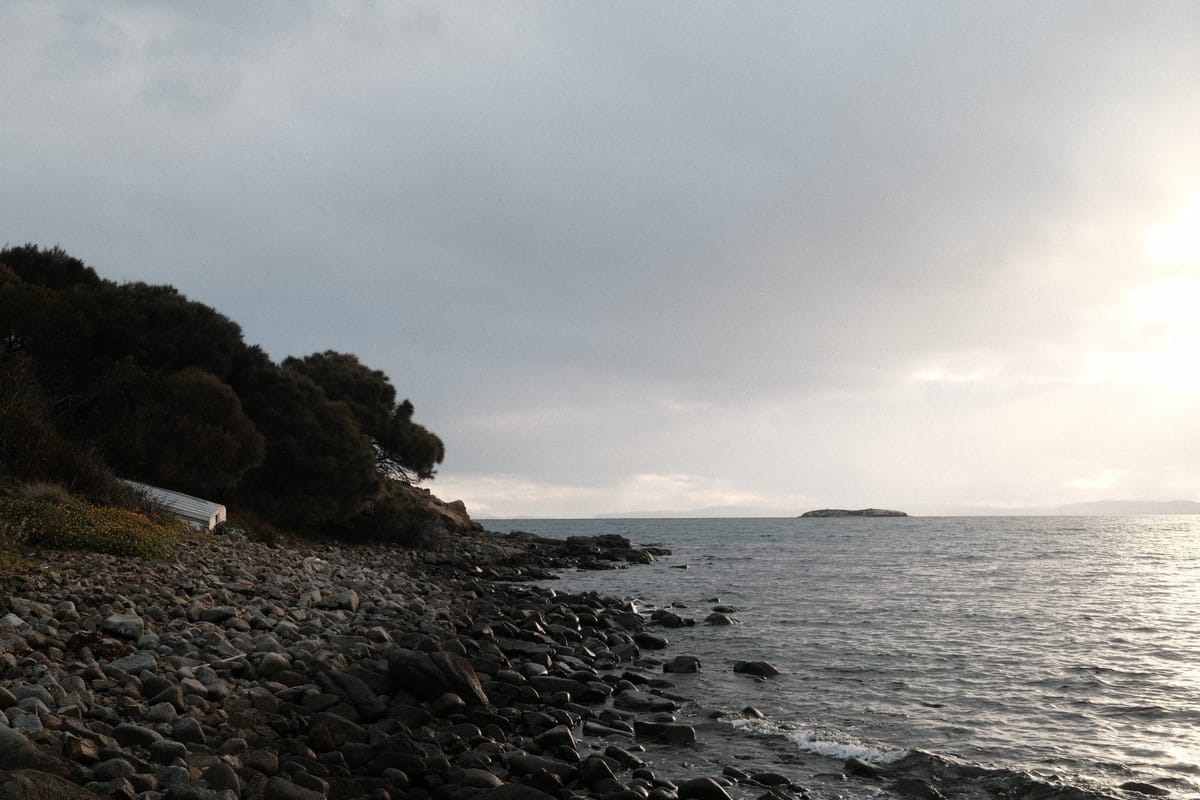
And then I’m at the beach, submerging myself in the waters of Ohinehou, and that line crystallises in my head. The whenua and the moana and the awa did not cause this hurt. The whenua and the moana and the awa have borne their own hurt, generations upon generations of hurt at the same hand that now hurts me.
In the end, those feelings of whakamā heading into the conference didn't last. They were replaced quickly with gratitude - a complex gratitude for a traumatic decision being made at just the right time. I think we all sought and found respite in nipaluna in different ways. For me, it was finding rest for the first time in over a week - finding rest in community, in other trans people.
I don't know yet how to feel about suing the government - it's not something you do every day - and I know everything that's happened over the last week is going to crystallise and become real as soon as I get home. But right now, I'm overwhelmed with gratitude that when I needed it more than I've ever needed it before in my life, trans people were there to save me. I described it as respite and as peer body doubling and, this morning, on a secluded beach outside of nipaluna, as a sense of total calm. I don't know how I would have got through without you all these last few days. I love you. I love trans people. I'm so grateful for you. I'm so grateful for trans people.
Thank you for reading this piece I mostly wrote for myself. I love you. What a year, aye? PATHA is raising funds for our legal challenge - but there's also a fundraiser about to launch to support the trans kids and whānau affected by this ban. I'll update this post with a link when it does. The legal challenge is just one part of this work, and there will be whānau needing financial support to be able to ensure their tamariki get the care they need. If you've already donated to PATHA - thank you, it means the world. If you haven't and were thinking about it, consider keeping some pūtea aside to support the access fundraiser, too.
Update: that fundraiser has now launched - you can find it here.
It's hard not being able to share everything I want to share. I'm looking forward to being able to write more in depth about everything that's happening at the moment. But for now, keep doing what you're doing - keep supporting the trans people in your life. Make sure people know that the trans community and the medical community are working together to make sure this ban doesn't last. We will take care of you.