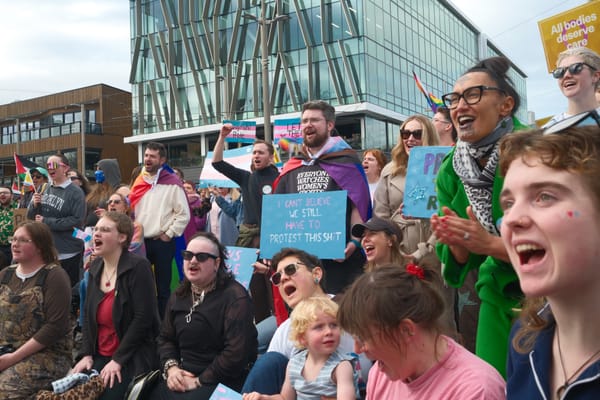
Time to sue the Government.
This week, the High Court will hear PATHA’s challenge to the Minister of Health’s regulation that bans new prescriptions of reversible pubertal suppression medication for transgender young people.

Mōrena koutou,
I'm writing this intro quickly in my hotel room. Later this morning our judicial review will begin to be heard in the High Court in Wellington. If you're local, you can come support - Wellington Pride have the details you need to know!
In the meantime here's the press release PATHA has published this morning summarising our case. Of note is the sex in the HRA section at the end - and that the Human Rights Commission themselves have intervened to advocate for a broad definition of 'sex' in that Act.
Judicial Review Challenging the Ban on Reversible Pubertal Suppression
This week, the High Court will hear PATHA’s challenge to the Minister of Health’s regulation that bans new prescriptions of reversible pubertal suppression medication for transgender young people.
PATHA was deeply concerned and blindsided by the Government’s decision to enact this ban on new prescriptions of reversible pubertal suppression medications. We consider that the Government, in introducing this regulation, chose to override clinical best practice in favour of an ideologically and politically driven policy that contravenes the Ministry of Health’s own advice. The Ministry of Health’s expert Evidence Review and Position Statement supported continued prescribing subject to existing safeguards, and its Regulatory Impact Statement did not support a ban and warned it would bring a “high risk of adverse health outcomes”. As such, we decided to pursue a legal challenge to this regulation.
We have heard from families and young people who have already been negatively impacted by the regulation, including those who are terrified that this medical option, which could improve their child’s wellbeing, has been taken away from them. For the wellbeing of our transgender tamariki, rangatahi and the overall transgender community, PATHA says these regulations must be set aside.
“Many professional healthcare bodies in Aotearoa New Zealand, have expressed concerns about the regulation, as this establishes a worrying new precedent where private and deeply personal clinical matters are subject to political policy decision-making,” said Dr Elizabeth McElrea, specialist general practitioner and PATHA Vice President. “Whether or not to pursue a particular treatment has been recognised throughout our history as a shared decision to be made by a clinician and a patient working together.”
“PATHA has and will continue to stand up for the health and rights of transgender people across Aotearoa,” said Jennifer Shields, PATHA President. “As such, we have challenged these regulations by way of judicial review on several grounds. The decision to enact this regulation by the Government is gross political overreach and will have lasting consequences for our transgender and gender diverse tamariki and rangatahi, across Aotearoa and around the world.”
Further Details on the Grounds for this Legal Challenge
No consultation
PATHA alleges that no consultation with relevant groups was held regarding a ban on reversible pubertal suppression. The Ministry of Health held a brief public consultation on potential restrictions on reversible pubertal suppression across late 2024 and early 2025. This was an unusual occurrence, as the Ministry of Health had never before held a consultation with the wider public on a clinical matter.
In the Ministry of Health’s consultation on potential restrictions, no mention was made of a complete ban on new prescriptions of reversible pubertal suppression medication. The feedback from this consultation showed wide support for the status quo and for the continued prescribing of reversible pubertal suppression medications by experienced practitioners as part of a multidisciplinary team, when clinically indicated.
PATHA alleges that at no point during this period was the option of a full ban considered; therefore, there was no meaningful consultation on the regulations made.
Wrong decision-maker
PATHA alleges that it was not the Minister of Health who decided to enact the regulations, but rather that it was taken by wider members of the cabinet.
The ban was announced by the Hon Casey Costello before the official announcement by the Minister of Health, and a campaign by NZ First claimed that the regulations were made as part of their policy - and that they only came about because NZ First “fought for it”
Improper purpose
Regulations are authorised under the Medicines Act to address matters related to medicines and to advance the purposes of the health system. PATHA says that these regulations do not align with these purposes of the Medicines Act.
The Medicines Act only authorises evidence-based regulations for purposes that relate to the clinical nature of medicines and their use. PATHA argues that there is no evidence-based clinical justification for this ban.
The Minister of Health’s Regulatory Impact Statement makes it clear that there are serious risks of significant harm from instituting a ban on prescribing reversible pubertal suppression medications, and that such a ban is not advisable. The ban puts an already vulnerable group at greater risk of adverse health outcomes, contrary to the government’s commitment to the Pae Ora (Healthy Futures) Act
Did not take into account, or violated, the Bill of Rights
PATHA alleges that the Minister of Health (or other deciding parties) failed to take into account or violated the New Zealand Bill of Rights Act (NZBORA) in several ways. Failing to take into account or violating:
The right not to be deprived of life
PATHA alleges that the Minister of Health has taken an action that has increased the threat to life. Uncontested evidence shows that the regulations will contribute to an increased risk of suicide in an already vulnerable group. The total nature of the ban also prevents clinicians from prescribing an appropriate medication where there is a high risk of suicide among transgender youth.
The right not to be subjected to torture or cruel treatment
PATHA alleges that the basis of the ban is inhumane, degrading and disproportionately severe for transgender people. Preventing people from accessing necessary and clinically appropriate medication will subject a generation of transgender young people to a future of inferior clinical care. This will force them to go through permanent changes to their bodies that can lead to profound distress with lifelong impact, rather than being able to access the appropriate and clinically safe alternative, which is to suppress puberty
The right not to be subjected to scientific or medical experimentation
The established gold standard of care for young people who need to pause their puberty is through reversible pubertal suppression medication. PATHA alleges that the ban is medical experimentation. Instead of allowing transgender young people to participate in clinically appropriate care, as affirmed by a significant number of professional bodies, the regulations force transgender young people to be subject to treatments that are unsubstantiated and potentially unethical. As well as proposing to make youth gender services more accessible if a ban was implemented, the Minister of Health stated that an “online hub” would be created to improve healthcare access for transgender young people. In practice, this is a page on the Health New Zealand website that simply links to existing underfunded services.
Freedom from discrimination
PATHA alleges that the regulations are discriminatory on the grounds that they explicitly apply only to transgender people, and therefore are unequivocally discriminatory. Cisgender (non-transgender) children are not affected by the ban and will continue to be prescribed this medication for other indications
Sex in the Human Rights Act
Since at least 2006 (if not earlier), the ground of sex in the Human Rights Act has been interpreted to include gender identity. This approach was informed by a legal opinion from the acting Solicitor General in response to a Member’s Bill proposed by MP Georgina Beyer seeking to expressly affirm the right to be protected from discrimination based on gender identity. In reliance on that opinion, the Government decided existing protections in the Human Rights Act were sufficient to protect trans people from discrimination and this has been the position adopted by subsequent governments and across all aspects of public decision making since then.
PATHA’s position is that the ban is discriminatory on the basis of sex, this longstanding interpretation is central to this case. The Crown has indicated that while it agrees that the ground of sex in the Human Rights Act includes gender, but has suggested that if the matter needed to be fully determined in this case, it will argue against that opinion. It seems likely that this long-held opinion will be determined in this hearing. The Human Rights Commission has intervened in support of an interpretation of sex in the Human Rights Act that includes gender.
“I’m concerned that the rights of trans people are once again up for debate this year,” said Shields. “While I’m confident this hearing will confirm the long-standing position that transgender people are protected from discrimination by the ground of sex, I can’t help but note the context this hearing is happening in. The Government had the opportunity to enact the very sensible recommendations of the Law Commission’s Ia Tangata report on the protections for trans and intersex people in the Human Rights Act. Instead they’ve chosen to progress a Member’s Bill that would do the opposite.”