Saltwater siblings
They are the kuia of the roto and the awa, ocean navigators and alpine explorers. They were welcoming us, fellow saltwater drinkers, to their freshwater heaven.

In workshops, one of the few ways I've found to describe gender dysphoria is with an analogy about salt water. Imagine, your whole life, you’d grown up drinking salt water. Every time you take a sip, it just dehydrates you further. Looking around, you can see that everyone else is doing the same thing - drinking water! Why isn't it working for you?
Then, one day, you have a glass of fresh water for the first time and suddenly it all makes sense.
Tuna kūwharuwharu, the New Zealand longfin eel, starts its life out at sea, somewhere between Tonga and New Caledonia. They drift on ocean currents in their larval stage, arriving at the shores of Aotearoa and growing into glass eels, 6cm long and translucent. They then begin a long journey upstream, transitioning from saltwater to brackish water to the crisp, clear waters of Aotearoa’s alpine lakes and rivers.
At the end of their life, they make this journey in reverse, after growing 9mm a year and living long, long lives. They swim back downstream, heading to the salt water of the ocean. They stop eating when they make it there, then travelling thousands of kilometres back to their spawning grounds where their life began.
When it’s their time to migrate, to return to salt, they grow blue rings around their eyes.
My own relationship to time is a weird one. Recently when people have asked how long I've been at Qtopia, I've had to stop to figure it out. I usually answer with a number I have in my back pocket - "oh, five years or so" - but that's not true any more. In reality, it's nearly seven, but it's been such a big part of my life for that whole time, so it feels longer.
Kei korā te pōraruraru, nē? Work has been such a big part of my life. I've known that would take its toll - was taking its toll - but a lot of the time that just feels like the reality of the mahi.
I came to this work at a really interesting time. A lot has changed in the last seven or so years. When I joined Q, we were just at the beginnings of what I think is probably fair to describe as a bit of a global backslide in terms of trans rights and acceptance. I think that's been most obvious in how my conversations with teachers and school counsellors have changed in that time - seven years ago it would have been pretty extraordinary for a school to have had to navigate a whānau in their community who was as ideologically opposed to trans inclusion as some are now. The disinformation epidemic has definitely changed the landscape - for now.
But this isn't a retrospective on my work, or our work. I'm not looking to assess what's changed and why. I'm here to talk about tuna.
I have this really vivid memory from high school about tuna. We were living in Tāmaki Makaurau when Ōtautahi was hit by the earthquake back in 2011. In the days? weeks? months? following, there was a news story about tuna in the city's drains, in the gutters on the road. I think the quake had ruptured pipes, and then heavy rain (or maybe the impact of liquefaction? I was a teenager at the time!) meant all of a sudden in parts of Ōtautahi tuna were in the gutters, left stranded when the waters receded.
"Ewwwww!" was the response when I brought it up to friends at school. "Eels are so gross!"
Honestly this stunned me, because tuna are SO cute. No one agreed with me, but I was adamant - and sad. The thought of these tuna stranded in a gutter - compounded by the absolute injustice of them being called 'gross‘, and the grief at watching my home affected by disaster from afar - seared that moment onto the back of my mind. Now, every time I cross the stream near my house, I look for the tuna. When it's been raining, there's usually one in the same spot every time. Kia ora e hoa. Kei te pēhea koe?
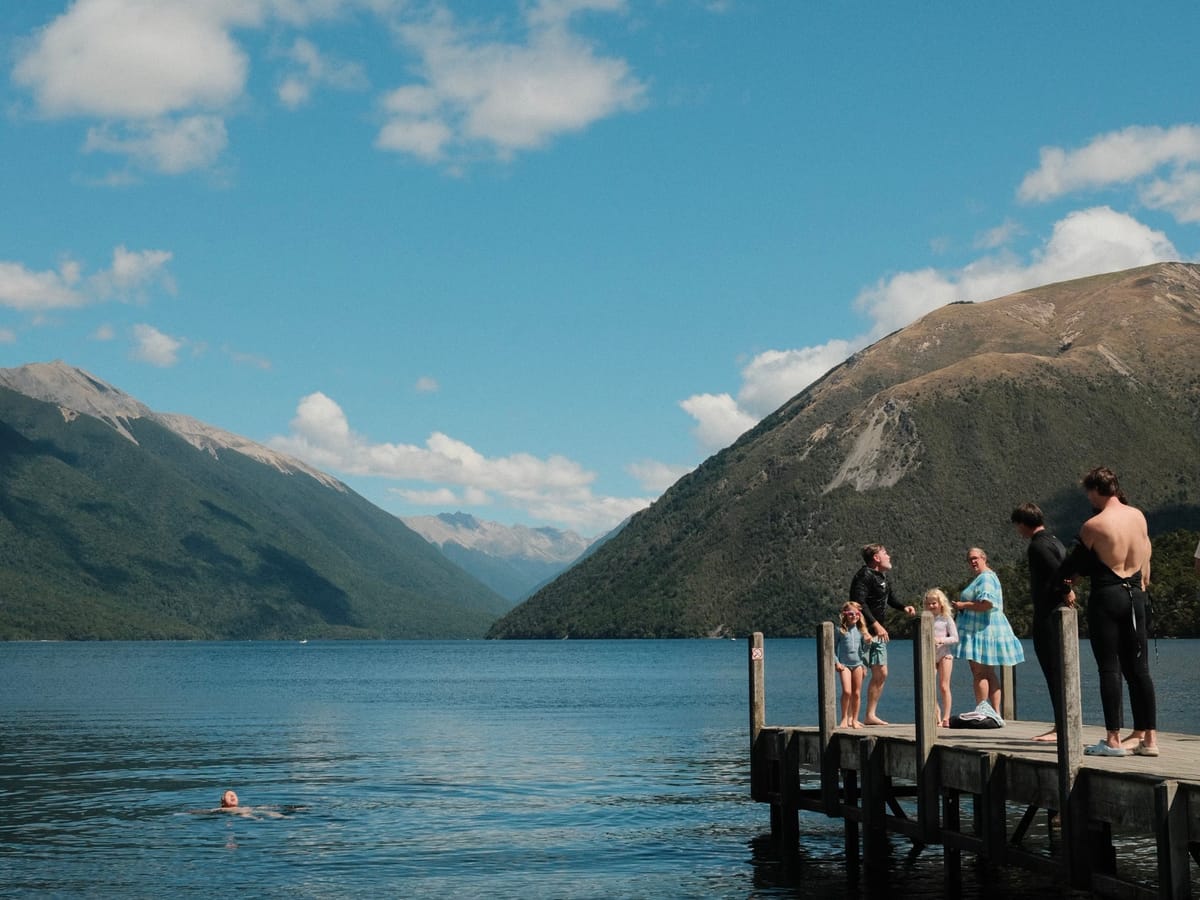
Yalei and I are swimming in the Buller River, right where it flows out of Rotoiti. We’ve seen the tuna down at the jetty, talked about wanting to meet them, to swim with them. I feel something brush against my toe, maybe a little nibble. I put it aside - I always imagine things underwater when I swim. Then the same thing happens against my thigh. I don’t have my glasses on, but I see what I think might be a little face looking up at me and jump out of the water.
I convince myself it was just the weeds in the current. “I don’t usually get paranoid when I’m stoned,” I say to Yalei. We sit back down in the river, laughing, and continue our conversation. It takes only a few minutes before the same thing happens to them, too.
We both run out of the river as fast as we can, shrieking, immediately feeling bad about how we’ve rejected the tuna. Later, we find out how old they are. They are the kuia of the roto and the awa, ocean navigators and alpine explorers. They were welcoming us, fellow saltwater drinkers, to their freshwater heaven.
There's something here about how even things we think are cute can still scare us when we don't feel like we're in control, or when we're feeling vulnerable, or when it's unexpected, or when we're not in our own element. It makes sense - so many things can be easier to think about or talk about, and much harder to do. Something can be great in theory but hard and scary in practice. Tuna can be cute when you're looking at them from dry land. You might even want to swim with them. But they can still give you a fright when you're in their awa not expecting a nibble.
I'm not just here to talk about tuna. The thing I am talking about here without talking about it is burnout, and what it takes to recover.
Today was my last day as Qtopia's Managing Director. I've known this was coming for a while. I am experiencing burnout.
Gosh, does it feel like I'm sitting in a circle at a group. Kia ora, ko Jen tōku ingoa, kua pau te hau, I am experiencing burnout. It's okay, I've accepted it. These things happen. I knew it probably would happen, at some point. I knew the way I was working was not sustainable. It was a matter of 'when', of how long a runway I could give myself with the things I could change, the wellbeing practices I could implement. And it's been a hard couple of years, what with the context and all. Despite that, working at Qtopia is the best thing I've ever done. We've come such a long way - I'm leaving now not just because of the burnout, but because I feel confident I can leave now. The team there have got this. They're incredible.
I'm sad about leaving them, and the uncertainty about what comes next makes me a bit nervous, but I think overall I'm hopeful. I'm proud of myself for doing what I need to do, and I'm incredibly grateful for all the people who have made my work possible and been so understanding about why I'm doing what I'm doing.
But I gotta be real - this is one of those things that was good and important in theory but real scary in practice. Kind of like when you're sitting in a river and suddenly make a new tuna friend.
I wrote part of this back at the start of the year. My friend Yalei came to visit us and we took a road trip up through Kaikōura to Whakatū and back through the Lewis Pass. The rest of it I wrote the day I handed in my resignation.
On one of the more difficult days I've had recently, I told my partner that I wanted to feel like I recognised myself again. I don't know when I stopped recognising myself, but that was a turning point.
When I've thought about what "recognising myself" might look like, art comes up a lot. I came to Qtopia from a stint freelancing - my dear friend Audrey and I started a business called Glitterbox Pursuits. We ran a pop-up arts festival, a queer club night, an arts-themed pub quiz (with karaoke and a meme round, no less!). In an act of real serendipity, we just happened to wrap up right before the first COVID-19 lockdowns.
I've always enjoyed having projects on the go, being able to do different things. Even at Qtopia that's been true. In my first couple of years at Q, I continued to have a production management role at the Ōtautahi Tiny Performance Festival (aka TinyFest). It was like my annual creativity release valve, and a dream gig, getting to come on board towards the end of the process for the on-the-ground delivery. But I think in the last couple of years, my projects have also been the mahi. And while I bring my creativity to all my work, it's not the same as having a project as separate to the day job as an arts festival.
Art and writing has always been a part of my life - but in the last year in particular it's taken a real back seat. I'm excited to make space for that again. I'm looking forward to re-establishing a writing practice, to picking up my camera more often, to think about an exhibition, to put on some parties - maybe this is finally the time I actually join a band (again).
So, I'll be writing here more often. I'm curious to hear if you have thoughts about what you might like to read. I think once I've built up the habit and feel good about it I'll enable the option for paid subscriptions, so if you have thoughts about that I'd love to hear those, too - though I don't think I'll use it as a paywall very often.
I won't be dropping everything. I don't think I could - this part of my work is just as much a part of me as the creative practices. I'm staying on at PATHA (pending re-election!), I'll be beginning to practise as a professional supervisor, and I've got some part-time contract work lined up through til the end of the year. Time to rest, recover, re-balance my life. Beyond that, I'm not sure yet. If you've got work you think I might be interested in, let me know!
Lots of things led to me needing to make this change, but lots of things made it possible, too. When Yalei visited, they brought with them a copy of Island, a lutruwita-based arts magazine with a piece they'd talked about written by Erin Riley. It's about wrestling, in the same way this piece is about tuna. It's about the ways we find value in our work, and how that can serve to keep us in it even when it's affecting our health in other ways. It's about how hard it is to quit.
At the start of the year, I read it solemnly, knowing I would need to do something similar. 'Dread' isn't quite the right word - maybe 'partly-conscious denial' is closer. Part of me knew I would need to step away. Another recoiled from the thought like an eel had brushed up against my thigh.
I remembered most the parts of Riley's piece that talked about the work and the relationship to it, but as I returned to it this week something new caught my heart - an almost playful sense of hope. The essay is punctuated with fantasies of a Gold Coast hinterlands mansion up for lottery. Riley and their partner don't win the lottery, but that's beside the point: "It was less an escape plan and more a metaphor for what we had been yearning for: a change of scene, space, time, leisure, something new, a different kind of life."
As I came to its end, this time the final paragraph of the essay jumped out at me:
Like the Undertaker's last ride, we looked ahead, and there were no bandanas flapping in the wind this time but a burgundy Subaru Forester packed full, the tiny house emptied, our jobs quit. Ahead was a year of something different - one in which there would not be one home, but many.
Because in the depths of burnout these last few months, I had car troubles - a cambelt due for replacement, a petrol hungry car in a fuel crisis, lost keys, one big piece of life admin on top of everything else that just felt like too much. I sold it, and bought an old, rattly, joyful and not-quite-burgundy Subaru Forester.
We don't know where exactly tuna kūwharuwharu go to breed. We know it's somewhere around Fiji, Tonga, and New Caledonia, but it's been described as one of science's great mysteries. I wonder how much the tuna remember from their journey to Aotearoa. Do they know where they're returning to? Does it feel like a leap of faith? Or is it many? What does it feel like when they enter salt water again? To have the vastness of Te Moana-nui-a-Kiwa ahead of them?
I'm trying to treat this like a great mystery. I don't know what will come next. That's something to be curious about. Won't it be exciting when I find out?
That night, we walk down to the pier to see whaea tuna and the kuia who welcomed us. Rotoiti looks like something from a Tourism NZ ad: the walk from the campervan to the jetty was pitch black aside from our head torches, but the peaks surrounding the lake are lit by the stars. When we turn our torches off, they're bright like you wouldn't believe.
We shine a light off the pier, and the tuna kūwharuwharu come to say pō mārie. I see that a particularly large tuna has a distinctive blue ring around her eyes. It’s nearly time for her to leave, to make that long migration, to usher in the next generation. I can’t help but feel a tinge of sadness mixed in with my awe, this ancient being coming to the end of her life cycle, young me facing some big life changes too, each of us looking at the other, making eye contact through the water, surrounded by stars.